A trans-institutional team of Vanderbilt engineering, data science and clinical researchers has developed a novel approach for monitoring bone stress in recreational and professional athletes, with the goal of anticipating and preventing injury. Using machine learning and biomechanical modeling techniques, the researchers built multisensory algorithms that combine data from lightweight, low-profile wearable sensors in shoes to estimate forces on the tibia, or shin bone鈥攁 common place for runners鈥� stress fractures.听听



The research builds off the researchers鈥櫶�2019 study,听which found that commercially available wearables do not accurately monitor stress fracture risks.听, assistant professor of mechanical engineering, biomedical engineering and physical medicine and rehabilitation, sought to develop a better technique to solve this problem.听鈥淭oday鈥檚 wearables听measure ground reaction forces鈥攈ow hard the foot impacts or pushes against the ground鈥攖o assess injury risks like stress fractures to the leg,鈥� Zelik said. 鈥淲hile it may seem intuitive to runners and clinicians that the force under your foot causes loading on your leg bones, most of your bone loading is actually from muscle contractions. It鈥檚 this repetitive loading on the bone that causes wear and tear and increases injury risk to bones, including the tibia.鈥�听
The article, 鈥淐ombining wearable sensor signals, machine learning and biomechanics to estimate tibial bone force and damage during running鈥� was published听听in the journal听Human Movement Science听on Oct. 22.听听听
The algorithms have resulted in bone force data that is up to four times more accurate than available wearables, and the study found that traditional wearable metrics based on how hard the foot hits the ground may be no more accurate for monitoring tibial bone load than counting steps with a pedometer.听听
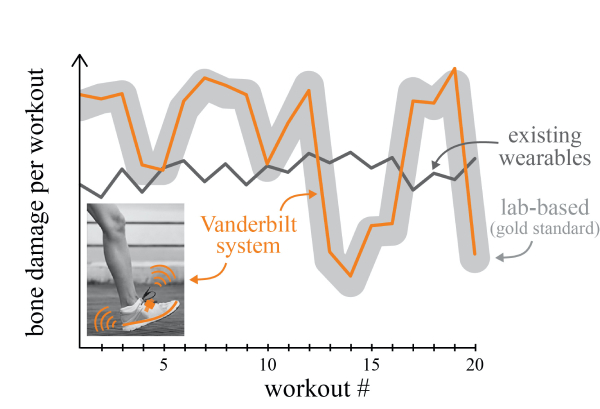
Bones naturally heal themselves, but if the rate of microdamage from repeated bone loading outpaces the rate of tissue healing, there is an increased risk of a stress fracture that can put a runner out of commission for two to three months. 鈥淪mall changes in bone load equate to exponential differences in bone microdamage,鈥� said Emily Matijevich, a graduate student and the director of the听听Motion Analysis Lab. 鈥淲e have found that 10 percent errors in force estimates cause 100 percent errors in damage estimates. Largely over- or under-estimating the bone damage that results from running has severe consequences for athletes trying to understand their injury risk over time. This highlights why it is so important for us to develop more accurate techniques to monitor bone load and design next-generation wearables.鈥� The ultimate goal of this tech is to better understand overuse injury risk factors and then prompt runners to take rest days or modify training before an injury occurs.听听
鈥淭he machine learning algorithm leverages the Least Absolute Shrinkage and Selection Operator regression, using a small group of sensors to generate highly accurate bone load estimates, with average errors of less than three percent, while simultaneously identifying the most valuable sensor inputs,鈥� said听, a research scientist at the Vanderbilt Institute for Software Integrated Systems. 鈥�I enjoyed being part of the team.听This is a highly practical application of machine learning, markedly demonstrating the power of interdisciplinary collaboration with real-life broader impact.鈥�听听
This research represents a major leap forward in health monitoring capabilities. This innovation is one of the first examples of a wearable technology that is both practical to wear in daily life and can accurately听monitor forces on and microdamage to musculoskeletal tissues.听The team has begun applying similar techniques to monitor low back loading and injury risks, designed for people in occupations that require repetitive lifting and bending. These wearables could track the efficacy of post-injury rehab or inform return-to-play or return-to-work decisions. 听听听
鈥淲e are excited about the potential for this kind of wearable technology to improve assessment, treatment and prevention of other injuries like Achilles tendonitis, heel stress fractures or low back strains,鈥� said听Matijevich, the paper鈥檚 corresponding author.听The group has filed multiple patents on their invention and is in discussions with wearable tech companies to commercialize these innovations.听听
This research was funded by National Institutes of Health grant R01EB028105 and the Vanderbilt University Discovery Grant program.听