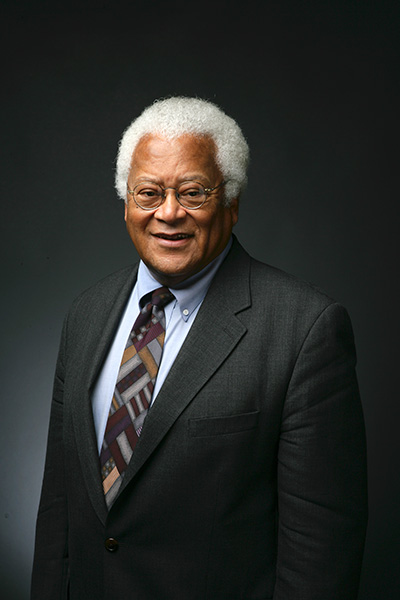
The Rev. James Morris Lawson Jr., a leader of the Civil Rights Movement who trained scores of activists during his time in Nashville鈥攎any of whom went on to prominence鈥攁nd whose expulsion from Vanderbilt in 1960 led to national headlines and prompted some faculty members to resign in protest, died Sunday, June 9, in Los Angeles. He was 95.
鈥淩everend Lawson聽was an American hero. Without his聽spiritual guidance,聽moral example聽and deep understanding of the principles and practices of nonviolent protest, the Civil Rights Movement as we know it might not have existed,鈥� Chancellor Daniel Diermeier said. 鈥淔or most of his life, he was a聽passionate聽advocate for justice and a more perfect union. He entreated us to engage with one another with love, not hate. And in a time of deep polarization, he showed us how to cherish our common humanity. The courage he demonstrated, and the grace he showed to Vanderbilt and others, show us the way forward still.鈥�
鈥淚 am deeply saddened by the passing of Rev. James Lawson,鈥� said Provost and Vice Chancellor for Academic Affairs C. Cybele Raver. 鈥淗is unwavering dedication to social justice and leadership development has left an indelible mark on our community. My thoughts and condolences go out to his family. His legacy of courage and compassion will continue to inspire us all.鈥�
Lawson, one of Vanderbilt鈥檚 most revered alumni, played an influential role in the peaceful protests of segregation during the 1960s by training Nashville college students in the principles of nonviolent change. He arrived at Vanderbilt Divinity School in 1958 as a 30-year-old transfer student from Oberlin School of Theology in Ohio with a passion for social justice. He had gone to jail as a conscientious objector during the Korean War. Then, as a missionary abroad, he had studied philosophies of nonviolence in India, the homeland of Mahatma Gandhi. He returned to Ohio in 1956, eager to apply activist strategies to the American scene. At Oberlin he met the Rev. Martin Luther King Jr., whose prestige as a civil rights prophet was nearing its height. Lawson鈥檚 experiences fascinated King, who urged him to come South in the struggle for justice for Black Americans.
Impressed with Vanderbilt and with the cadre of educated African American students in the local Black colleges, Lawson came to Nashville as staff organizer for the peace-oriented Fellowship of Reconciliation, as well as a divinity student. He also served as the southern director for the Congress of Racial Equality and conducted workshops in nonviolence techniques for students from Tennessee State University, Fisk University and Vanderbilt. Among the students he tutored were John Lewis, who went on to chair the Student Nonviolent Coordinating Committee and later to serve in Congress, Diane Nash, Bernard Lafayette and Marion Barry.
His work as a staff organizer for the Fellowship of Reconciliation alarmed members of Vanderbilt鈥檚 Board of Trust, and for his activism, Lawson was expelled from Vanderbilt in 1960.
The resulting turmoil pitted the Divinity School鈥檚 pro-Lawson supporters against Chancellor Harvie Branscomb and the Vanderbilt Board of Trust and sparked national debate. In 1996, 36 years after Lawson鈥檚 expulsion, then-Divinity School Dean Joseph Hough arranged a meeting between Reverend Lawson and former Chancellor Branscomb, who was then 101 years old.
鈥淲e actually visited as two human beings,鈥� Lawson recalled in a 2002 article for Vanderbilt Magazine, 鈥渁s men who had been seen as adversaries. We had a very pleasant visit in his home. I felt no animosity in the man, and I had none toward him. He by then had recognized that he allowed some things to take a wrong turn in 1960, and he let me know he had moved beyond where he was. I let him know that at no time did I harbor any ill will toward him, and that I never broke faith with him as a fellow United Methodist.鈥�
Reverend Lawson鈥檚 reconciliation with Vanderbilt led to his being named recipient of Vanderbilt Divinity School鈥檚 first Distinguished Alumni/ae Award in 1996.
Lawson returned to Vanderbilt as a Distinguished Professor, teaching from 2006 to 2009. In 2007, the James M. Lawson Jr. Chair at Vanderbilt was established in his honor. He donated a significant portion of his papers to the Jean and Alexander Heard Libraries鈥� Special Collections in 2013. Also, two scholarships at Vanderbilt have been established in his honor鈥攐ne for undergraduate students in 2018 and another for Divinity School students in 2020. In 2021, the Metropolitan Nashville Board of Public Education voted unanimously to recognize Lawson by naming Nashville鈥檚 newest high school after him; board member and Vanderbilt alumna Abigail Tylor advocated for the change. The new school, which replaced Hillwood High School, opened in the Bellevue neighborhood in 2023. He received in March 2021 the prestigious NAACP Chairman鈥檚 Award, which recognizes individuals who demonstrate exemplary public service and use their distinct platforms to create agents of change. Past recipients of the award include then-Sen. Barack Obama; Reps. John Lewis and Maxine Waters; former Surgeon General Regina Benjamin; actors Tyler Perry, Ruby Dee and Danny Glover; and musicians The Neville Brothers and Bono.
With Lawson鈥檚 support, the James Lawson Institute for the Research and Study of Nonviolent Movement was created in 2022 at Vanderbilt. The institute is a trans-institutional collaboration between the Divinity School and the College of Arts and Science that advances evidence-based research and nonviolent change while preparing the next generation of leaders, humanitarians and community organizers. Reverend Lawson spoke at the launch of the institute in April of that year.
鈥淭his institute will help Vanderbilt 鈥榖e on the map around the world鈥� for the kind of social change鈥攑ersonal and social transformation鈥攖hat will save the race, the human race, that is, and save the times in which we live,鈥� Lawson said. 鈥淲e do no ordinary thing here. We are not engaged in something that we can see, but the possibilities are infinite. I鈥檓 so grateful for this moment.鈥�
According to The New York Times, Reverend Lawson is survived by his wife, Dorothy, sons Morris and John, a brother, and three grandchildren. He was predeceased by his son Seth.